Family Dinner Ideas: Five Nights, One Shop, and the Prep Between Them
Published 2026-10-16 · Updated 2026-10-16
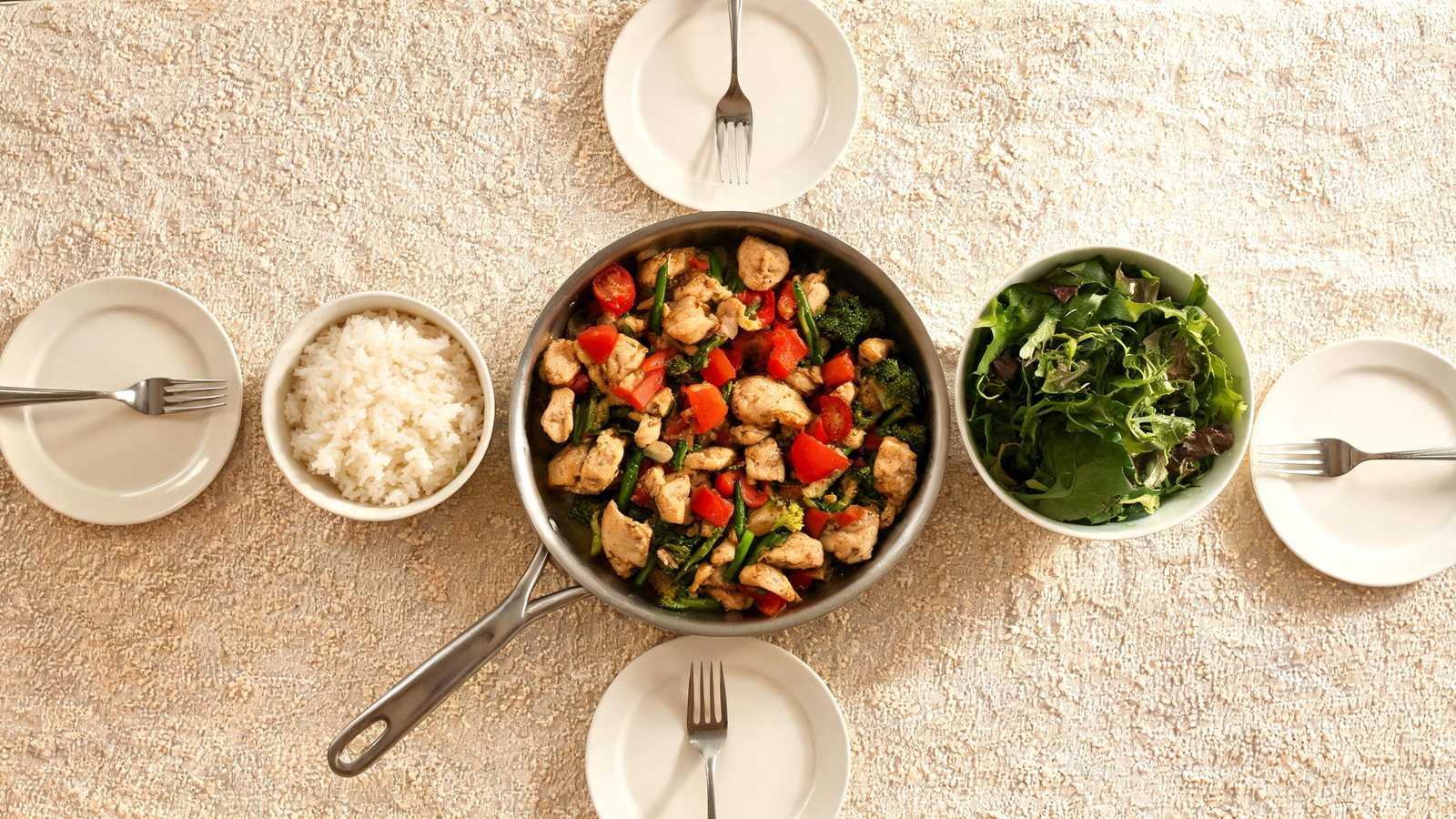
Cook five family dinners this week, one job each weeknight, and shop once for the parts they share. Pick one dish under each job.
- Monday, skillet: chicken with broccoli and rice; beef and peppers over rice; sausage, potatoes and a green vegetable.
- Tuesday, pasta: tomato-meat sauce with spaghetti; baked pasta from that same sauce; noodles with the protein on the side.
- Wednesday, build-your-own plate: tacos; baked potatoes with toppings; rice bowls.
- Thursday, pot: chili; chicken and vegetable soup; a bean stew.
- Friday, cozy bake: roast chicken with two sides; sheet-pan fish and potatoes; eggs, potatoes and toast.
That is the menu. The proteins and starches to build the shop around are chicken, ground beef, sausage, fish, eggs, rice, pasta, potatoes, tortillas and beans; vegetables, a tomato sauce or canned tomatoes, broth and bread fill out the rest of the list. The shop, the fridge clock and the prep that carries from one night to the next come after the list. A scroll of single recipes is useful once you already know the night. It does not tell you what to buy, or which protein still belongs in the refrigerator by Friday.
The five jobs and the dishes under them
Each weeknight has one job so you are not choosing from a blank page at 5 p.m.
The skillet night is one pan plus a starch. Chicken with broccoli and rice, beef and peppers over rice, or sausage with potatoes and a green vegetable. The pan is the dinner. A salad or bread on the side is enough if you want a second texture.
The pasta night is a sauce you can also bake. Tomato-meat sauce with spaghetti, that same sauce under baked pasta, or noodles with the protein kept on the side so one plate can stay plain. Keeping the protein off the noodles is a plate choice, not a second menu. If someone at the table refuses mixed dishes, the longer swap logic is on the dinner ideas for picky eaters page.
The build-your-own night keeps parts apart on purpose. Tacos, baked potatoes with toppings, or rice bowls. Tortillas, potatoes or rice go down first. Protein, a vegetable and a sauce stay in their own bowls. Everyone assembles a plate. You still cooked one dinner.
The pot night is the dinner you meant to eat twice. Chili, chicken and vegetable soup, or a bean stew. Make the pot large enough for a second meal. A soup or stew with meat added is the category to check on the storage chart below, not a guess.
The cozy bake is the night the table looks settled. Roast chicken with two sides, sheet-pan fish and potatoes, or eggs with potatoes and toast when you want breakfast for dinner. Serve it from the pan or a platter. This is the answer when the question is a cozy dinner tonight, even if tonight is not Friday.
A short night, when the hands-on work has to stay small, is a different job. Use the fast family dinners page for that, and keep this rotation for the week as a whole.
One shop, timed to the fridge
Buy the shared parts once. Write them as a list, not as five separate recipes. The way to turn that list into a store trip is on the grocery list page. Ingredient prices are a different question; the cheap dinner ideas page is the place for that.
Group the shop like this:
- Protein for the first cooked nights: chicken pieces for the skillet and, if you will cook it soon, the pot. Ground meat for the pasta sauce or the chili.
- A roast, chops or fish for the cozy night, bought as its own line.
- Starch the nights share: rice, pasta, potatoes, tortillas or bread.
- Vegetables: one for the skillet, one for the pot, one fresh for the side.
- A sauce base: canned tomatoes, broth, or both.
- Something to put next to the main: salad greens, fruit, or bread if the starch is already rice.
The clock on that shop comes from the FoodSafety.gov cold storage chart. Keep the refrigerator at 40°F or below. Fresh chicken or turkey pieces keep 1 to 2 days in that refrigerator, and ground meat keeps 1 to 2 days, while steaks, chops and roasts keep 3 to 5 days.
So a Sunday shop covers Monday and Tuesday chicken. It does not cover Friday chicken unless you freeze the Friday portion. The same chart lists chicken or turkey pieces for 9 months in the freezer. Freezer month counts on that chart are for quality only, and food held continuously at 0°F can be kept indefinitely. A Friday beef or pork roast bought Sunday can wait in the refrigerator, because beef, veal, lamb and pork roasts are in the 3 to 5 day line on that chart. A whole chicken is not: the chart's fresh poultry row gives a whole chicken 1 to 2 days, so a Friday roast chicken bought on Sunday goes into the freezer that day and thaws in the refrigerator before Friday.
Cooked food has a different clock. Cooked meat or poultry leftovers keep 3 to 4 days in the refrigerator and 2 to 6 months in the freezer, on that FoodSafety.gov chart. A soup or stew with vegetable or meat added keeps 3 to 4 days in the refrigerator on the same chart. Thursday's pot can be a second dinner on Friday or Saturday. It is the wrong pot to hold until the next Thursday.
After cooking, the table has a clock too. Within 2 hours of cooking, refrigerate leftovers, and throw away perishable food left at room temperature more than 2 hours, or 1 hour if the air is over 90°F, as USDA FSIS leftovers guidance states.
Temperatures belong on a thermometer, not on a color guess. Reheat leftovers and casseroles to 165°F, cook all poultry to 165°F, cook ground meat to 160°F, and cook steaks, chops and roasts to 145°F with a rest of 3 minutes, as the USDA FSIS temperature chart lists. The same chart says people may cook hotter than those minimums if they prefer it. Longer storage notes for each kind of leftover are on the how long leftovers keep page.
Prep that the next night uses
Do the shared work on the night you will still be inside the chart, not "sometime this week."
On the skillet night, cook enough rice for that plate and for Wednesday's rice bowls only if Wednesday is still inside the leftover window for the food the rice is mixed with. If you are not sure which line on the chart the mixed dish falls under, cook the rice the night you serve it. The chart, not a habit, is the limit.
On the pasta night, brown the ground meat into the sauce and hold the cooked sauce as cooked meat leftovers: 3 to 4 days in the refrigerator on the FoodSafety.gov chart. Baked pasta the next night uses that sauce. It is not a new shop.
On the pot night, make the pot large enough for one planned second meal. Chill it in shallow containers so it cools, then cover it. The USDA FSIS leftovers page says to divide large amounts into shallow containers and to refrigerate leftovers within 2 hours. Reheat that second meal to 165°F.
Chop the vegetables for two nights at once only when both nights fall inside the raw-meat window if the vegetables are packed with raw meat. Packed separately, the vegetables are not on the meat line. Keep raw chicken and raw ground meat on their own 1 to 2 day clock, and freeze what you will not cook inside it.
A blank week you fill yourself, including a place to write this prep, is the job of how to make a meal plan. This page is the five jobs and the shop that feeds them.
The 12-Week Family Dinner Plan includes 12 weekly overviews with a Do before you cook box, 60 original family dinner recipes, and 12 grocery lists sorted by aisle, plus a start page with a filled sample grocery list. It is a print-only PDF of 90 pages in US Letter and A4, in one ZIP, at $11.00. Every recipe serves 4; there is no list for other household sizes.
Tonight, two people, or a cozy table
If the only question is dinner tonight, ignore the calendar and match the job to the fridge. Chicken pieces that must be cooked soon mean the skillet. Ground meat that must be cooked soon means the pasta or the chili. A beef or pork roast still inside its 3 to 5 days, or a thawed whole chicken, means the cozy bake. Nothing thawed means the build-your-own night from pantry starch, eggs or beans, or a trip for the one protein you will cook today.
Two people can cook the family pan and eat the rest as the planned second meal, inside the 3 to 4 day leftover window. This rotation does not resize a recipe. It only stops a second full dinner from being invented at the table.
No ideas is the skillet. Write the five jobs on paper even if you cook only one of them tonight. The limit of this advice is plain: a rotation will not make a refused food acceptable. You still choose foods the household already eats. The jobs only stop the blank-page scramble.
A family of four is the shape of the list: one protein, one starch, one vegetable, shared pans. If your table is larger or smaller, cook the amount you finish and keep the clocks. The printed plan above is built at four servings, which is the limit that matters if your household is not four.
What the recipe scrolls leave out
The first result lists 50+ meal ideas and has no five-night rotation or shopping list. It is a long gallery of single recipes, grouped by dish type, with a link out to each recipe. Useful when you want a specific dish. Silent on what to buy once, and silent on which protein is still a refrigerator item by Friday.
The second result is a recipe-category index and has no weeknight rotation or shopping list. It points at collections of dinners.
A challenge page blocked one gallery in the top results, so this rotation is compared with the two pages that loaded. Those pages are stronger when you already know the dish and want the recipe. This page is stronger when the question is the week: five jobs, one shop, and the fridge clock between them.
One week written out (illustrative)
This week is a filled example, not a tested menu and not a store price.
- Monday: chicken, broccoli and rice in one skillet.
- Tuesday: tomato-meat sauce and spaghetti. Extra sauce held for Wednesday's baked pasta only in this example's story, not as a storage rule.
- Wednesday: rice bowls, parts in separate bowls, using rice cooked that night.
- Thursday: chicken and vegetable soup, pot sized for a second bowl on Friday lunch in the story.
- Friday: roast chicken, potatoes and a green side. The whole chicken is its own line on the shop, not the Monday chicken, and it goes into the freezer on Sunday and moves to the refrigerator to thaw during the week (the 1 to 2 day poultry line rules out keeping it raw in the refrigerator until Friday).
Shop lines in this example: chicken pieces, a whole chicken (frozen until it thaws for Friday), ground meat, rice, pasta, potatoes, broccoli, a soup vegetable, salad greens, tortillas left off because Wednesday is bowls, canned tomatoes, broth, bread. Rice appears once as an ingredient and twice as a night only because Wednesday's rice is cooked that night. The roast is not the skillet chicken. That is the whole point of writing the week before the store: shared lines collapse, and the protein that cannot wait gets its own plan.
Questions
What should I have for dinner tonight with my family?
Pick the job that matches what is already thawed: a skillet if chicken pieces are in the fridge, pasta if ground meat is, a pot if you cooked extra earlier, or the cozy bake if a roast is waiting. The list at the top is the menu.
What can I make for dinner if I have no ideas?
Start with the skillet job. One pan of chicken, a starch and a vegetable is a complete family dinner. Write the other four jobs down so the next night is not another blank.
What to make for dinner tonight cozy?
Use the Friday job on any night: roast chicken or a pot of soup, served from the pan at the table, with a plain side.
What to make for dinner with 2 people?
Cook the family pan and plan the second meal inside the leftover window in the fridge section. This page stops at a shared pan and a second meal.
What is a good meal for a family of four?
One protein, one starch and one vegetable from the same pans. Cook the amount your table actually finishes, then keep cooked leftovers inside the chart window above.
What are some easy dinner ideas for a family?
The dishes under the five jobs: skillets, pasta, build-your-own plates, pots and a cozy bake. Pick one dish per night.
What are some easy meal plans for a family?
Repeat the five jobs next week and swap the dish under each job. A filled calendar is the next step on the meal ideas for the week page.
What is an easy but impressive dinner?
The cozy bake. A roast chicken with two sides looks like a Sunday table and still comes from the same shop as the skillet night.