How Long Are Leftovers Good For?
Published 2026-10-16 · Updated 2026-10-16
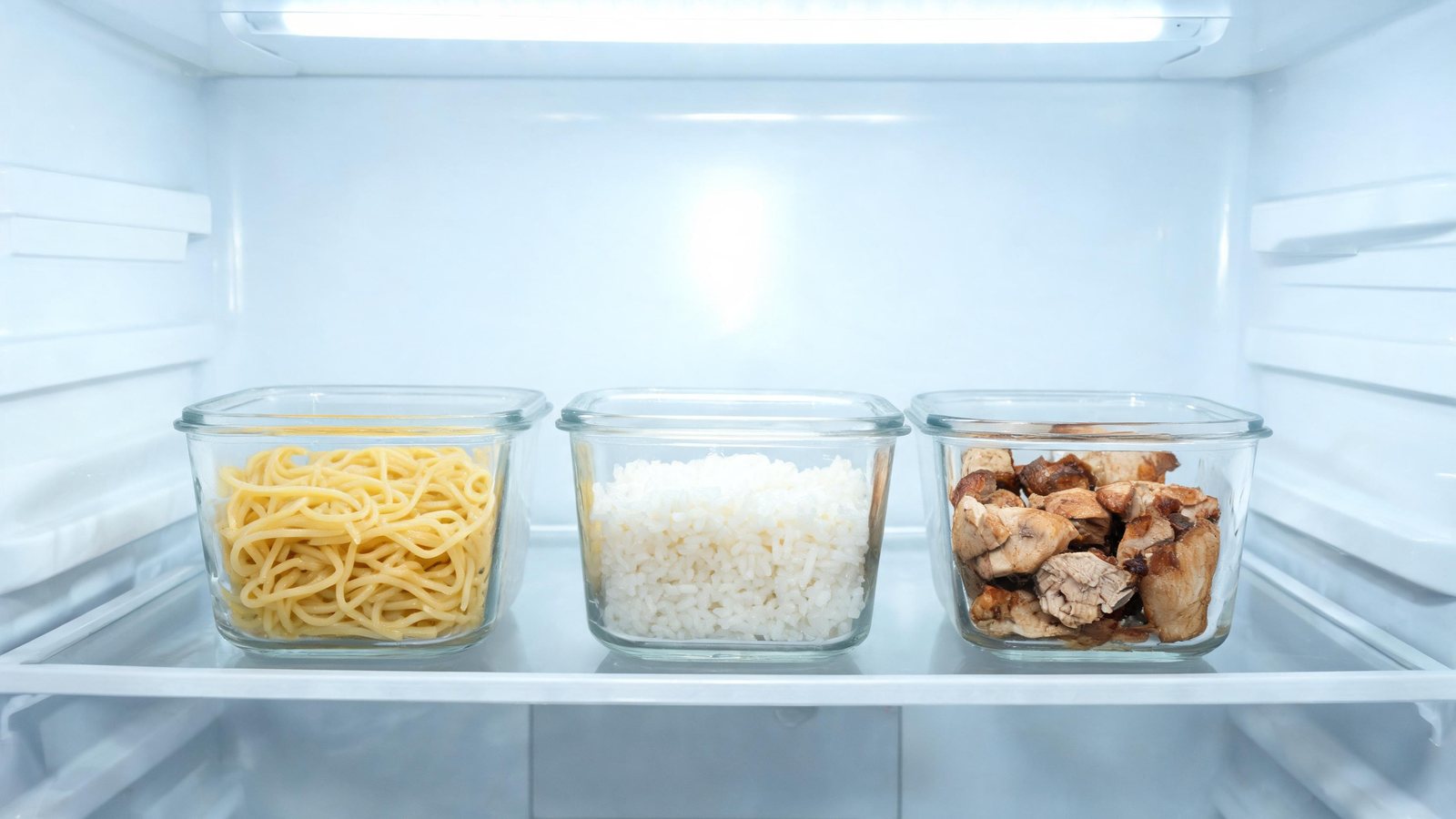
Cooked meat or poultry leftovers keep 3 to 4 days in the refrigerator and 2 to 6 months in the freezer for quality, on the FoodSafety.gov Cold Food Storage Chart. The USDA leftovers page gives the same refrigerator window, 3 to 4 days, and a general freezer line of 3 to 4 months. Refrigerate leftovers within 2 hours of cooking, or within 1 hour if the room is over 90°F, and reheat them to 165°F.
The chart was last reviewed on September 19, 2023. The USDA leftovers page was last updated on Jul 31, 2020. Fridge times below are the short home-storage limits. Freezer times are quality guidance for food held at 0°F. Food held continuously at that temperature can be kept indefinitely, which the chart states beside its quality-only note.
Fridge and freezer times for dinner leftovers
Set the refrigerator at 40°F or below and the freezer at 0°F or below. The chart says those short refrigerator limits help keep home-refrigerated food from spoiling or becoming dangerous to eat. The freezer column on that chart is for quality only.
| Food | Refrigerator | Freezer, quality |
|---|---|---|
| Cooked meat or poultry | 3 to 4 days | 2 to 6 months |
| Soups and stews, vegetable or meat added | 3 to 4 days | 2 to 3 months |
| Pizza | 3 to 4 days | 1 to 2 months |
| Chicken nuggets or patties | 3 to 4 days | 1 to 3 months |
| Egg, chicken, ham, tuna, and macaroni salads | 3 to 4 days | Freezes poorly |
| Casseroles with eggs, after baking | 3 to 4 days | 2 to 3 months |
| Fresh ham, uncured, cooked | 3 to 4 days | 3 to 4 months |
| Cooked ham, store-wrapped slices, half, or spiral cut | 3 to 5 days | 1 to 2 months |
| Cooked ham, store-wrapped, whole | 1 week | 1 to 2 months |
| Hard-cooked eggs | 1 week | Freezes poorly |
The USDA leftovers page states leftovers can be kept in the refrigerator for 3 to 4 days or frozen for 3 to 4 months. That freezer line is tighter than the chart's 2 to 6 months for cooked meat or poultry. Use the chart row for the food in the container, and read the USDA 3 to 4 month line as the general leftovers statement. For flavor, the shorter quality window is the cautious choice. A freezer month on either page is a quality mark for food held at 0°F. The chart says food stored continuously at that temperature can be kept indefinitely.
The two-hour window after cooking
Bacteria grow rapidly between 40°F and 140°F, the range the USDA leftovers page calls the danger zone. Within 2 hours of cooking, or after food comes off an appliance that was keeping it warm, leftovers go into the refrigerator. The same page says to throw away perishable food left at room temperature for more than 2 hours. The limit is 1 hour when the temperature is over 90°F, including a summer picnic outdoors.
Cold perishable food, such as chicken salad or a platter of deli meats, stays at 40°F or below while it is served. Cold leftovers that stay at room temperature for more than 2 hours are past the same limit, and the limit is 1 hour above 90°F. Both of those limits are on the USDA leftovers page.
Cool leftovers in shallow containers
A big pot of soup cools slowly, and slow cooling is the problem the USDA leftovers page names. Divide large amounts into shallow containers so the food reaches 40°F faster. Slice a roast or a ham, and cut turkey into smaller pieces, before it goes into the refrigerator. Slice the breast. Legs and wings may stay whole. Hot food can go straight into the refrigerator, or into an ice or cold water bath first.
Cover leftovers, wrap them, or seal them in a container. That keeps other fridge odors off the food and holds moisture. Write the food and the date on the lid so the chart window is a date you can see.
Reheat to a measured temperature
Reheat leftovers to 165°F, measured with a food thermometer. Bring sauces, soups, and gravies to a rolling boil. Cover the food so heat reaches the center. In a microwave, cover and rotate the food, check the temperature in several places, and allow a resting time before the final check. The USDA leftovers page flags cold spots in a microwave.
The USDA leftovers page says frozen leftovers can be reheated still frozen, in a saucepan or microwave for soup or stew, and in the oven or microwave for a casserole. Reheating takes longer than a thawed start. That page calls reheating from frozen safe when time is short. After a reheat to 165°F, any remainder can be refrozen. If a container was thawed in the refrigerator and only part of it is needed, the same page says to take that portion and refreeze the rest.
Cooking comes before storage. The leftovers page says to cook ground beef, pork, lamb and veal to 160°F and all poultry, including ground turkey and ground chicken, to 165°F, measured with a food thermometer, before the food becomes a leftover.
Turkey, ham, and cooked ground meat
Leftover turkey follows the cooked meat or poultry row: 3 to 4 days in the refrigerator and 2 to 6 months in the freezer for quality. The USDA general freezer line is 3 to 4 months. Cut the bird into smaller pieces so it cools, which the leftovers page asks for.
Cooked ground turkey uses that same leftover row, 3 to 4 days. The raw ground row is a different line. Raw hamburger, ground beef, turkey, chicken, and other ground poultry are listed at 1 to 2 days in the refrigerator before cooking. Day 5 of cooked ground turkey is past the 3 to 4 day leftover line.
Ham follows the row that matches the package. Fresh, uncured, cooked ham is 3 to 4 days in the refrigerator and 3 to 4 months in the freezer. Cooked, store-wrapped slices, a half, or a spiral cut are 3 to 5 days in the refrigerator and 1 to 2 months in the freezer. Day 5 is the end of that fridge line. Day 6 is past it. A cooked, store-wrapped whole ham is listed at 1 week in the refrigerator, which still includes day 6, and at 1 to 2 months in the freezer.
Meal prep that stays inside the chart
Cook on Sunday and refrigerate that day. Portions eaten over the next 3 to 4 days match the cooked meat or poultry line. The chart lists 3 to 4 days and leaves the start-day count unstated, so mark the day you refrigerated the food and stay inside a window you can count on the container.
A plan that keeps every cooked portion in the fridge for 7 days runs past that line. A fifth fridge day does too. Portions for a 5th, 6th, or 7th day belong in the freezer on prep day, labelled with the food and the date. Thaw them in the refrigerator, then use them within 3 to 4 days, which is the window the USDA leftovers page gives after refrigerator thawing. A second cook midweek starts a new fridge window. A first session for family dinners is laid out in how to meal prep. Dinners that belong in the freezer, and the ones that freeze poorly, are sorted in freezer meals.
What lasts 5 days on the chart is a different list from cooked leftovers. Opened luncheon meat or deli slices are 3 to 5 days. Raw steaks, chops, and roasts are 3 to 5 days. Hard-cooked eggs are 1 week, and the chart marks them as freezing poorly. Bacon is 1 week in the refrigerator. Those rows answer which foods the chart lists at 5 days or longer. A pan of cooked chicken stays on the 3 to 4 day leftover line even when another row reaches 5 days.
Three days of cooked dinners from one cook sits inside the 3 to 4 day line. Four days sits at the far end of it. Seven fridge days run past the cooked leftover line. For a week of dinners, freeze the later portions on the day you cook them, or split the week into two cooks. Which dinners to put on that list is in meal prep dinner ideas.
The StateFoodSafety leftovers page says the FDA Food Code calls for throwing out opened or prepared perishable food after 7 days, maximum, and its chart lists egg, chicken, ham, tuna, and macaroni salads at 3 to 5 days. The FoodSafety.gov chart lists those salads at 3 to 4 days. That training page carries a modified date of January 22, 2014. Home leftovers on this page follow the FoodSafety.gov rows. The StateFoodSafety leftovers page omits a 2-hour limit and a 165°F reheating step.
Popular leftover rules, named against the chart
Searchers ask about a 2-2-2 rule and a 2-2-4 rule for leftovers. Neither the USDA leftovers page nor the FoodSafety.gov chart uses those labels. The rules those pages state are a 2-hour refrigeration limit, 1 hour when the room is over 90°F, a 3 to 4 day refrigerator window, and a reheat to 165°F.
Where the chart stops
The chart is a general home guideline. It reads a published row, and it leaves your own fridge unmeasured. A refrigerator warmer than 40°F is outside the storage condition the chart names. Freezer months are a quality window for food held at 0°F, and the chart says food held continuously at that temperature can be kept indefinitely. This page cannot measure your fridge, your freezer, or the dish you cooked tonight. If the container has a missing date, the chart window has no start you can apply.
When later days need the freezer
Once the fridge window is full, the rest of the week is a freezer job. Label each container with the food and the date you froze it. Thaw in the refrigerator, then cook or reheat to the temperature the leftovers page names.
The Prep-Ahead Freezer Dinner Kit is a print-only PDF with 10 original freezer dinners for 4, 2 prep sessions, a freezer label sheet, a freezer inventory page, and a freezer basics page with sourced temperatures and storage times. The Prep-Ahead Freezer Dinner Kit comes as one ZIP with separate US Letter and A4 PDFs, 23 pages. The Prep-Ahead Freezer Dinner Kit is $8.00.
Freezer times in the Prep-Ahead Freezer Dinner Kit are quality guidance from a university extension chart, not a safety limit for these exact recipes. The fridge and freezer table on this page comes from the FoodSafety.gov chart, a different source from that kit page.
A slow cooker changes the thaw step before cooking. Slow cooker meal prep states that rule before any bag goes into the pot.
Questions
Is cooked ground turkey still good after 5 days in the fridge?
Cooked ground turkey follows the cooked meat or poultry row on the Cold Food Storage Chart, 3 to 4 days in the refrigerator. A fifth day is past that row. Raw ground turkey is listed at 1 to 2 days before it is cooked.
How long is leftover turkey good for in the refrigerator?
Leftover cooked turkey is on the cooked meat or poultry row, 3 to 4 days in the refrigerator. The freezer quality line on that row is 2 to 6 months. The USDA leftovers page states a general freezer line of 3 to 4 months.
Is ham still good after 5 days in the fridge?
Fresh, uncured, cooked ham is listed at 3 to 4 days. Cooked, store-wrapped slices, a half, or a spiral cut are listed at 3 to 5 days, so day 5 is the end of that row. A cooked, store-wrapped whole ham is listed at 1 week.
Is ham still good after 6 days in the fridge?
Day 6 is past the 3 to 5 day row for cooked, store-wrapped slices, a half, or a spiral cut. A cooked, store-wrapped whole ham is listed at 1 week, which still includes day 6.
What is the 2 2 2 rule for leftovers?
Neither the USDA leftovers page nor the FoodSafety.gov chart uses a 2-2-2 label. Those pages state a 2-hour limit, a 3 to 4 day refrigerator window, and a reheat to 165°F.
What is the 2 2 4 rule for leftovers?
The USDA leftovers page and the FoodSafety.gov chart state a 2-hour limit, 1 hour over 90°F, and a 3 to 4 day fridge window. The labels 2-2-2 and 2-2-4 are unused on both pages.
Is it safe to meal prep for 7 days?
Cooked meat or poultry leftovers are listed at 3 to 4 days in the refrigerator. A 7-day fridge plan runs past that row. Freeze the later portions on prep day, or cook again midweek.
What can I meal prep that will last 5 days?
Freeze the portion for day 5 on prep day. Cooked leftovers on the Cold Food Storage Chart are listed at 3 to 4 days in the refrigerator. Opened luncheon meat is listed at 3 to 5 days, and hard-cooked eggs at 1 week.
Is meal prepping for 4 days safe?
Four days sits at the far end of the 3 to 4 day cooked-leftover row. The chart leaves the start-day count unstated, so mark the date you refrigerated the food and stay inside a window you can count.
What food lasts 5 days in the fridge?
Opened luncheon meat is listed at 3 to 5 days. Raw steaks, chops, and roasts are listed at 3 to 5 days. Hard-cooked eggs and bacon are listed at 1 week. Cooked meat or poultry leftovers are listed at 3 to 4 days.