Freezer Meal Prep: The Session Order
Published 2026-10-16 · Updated 2026-10-16
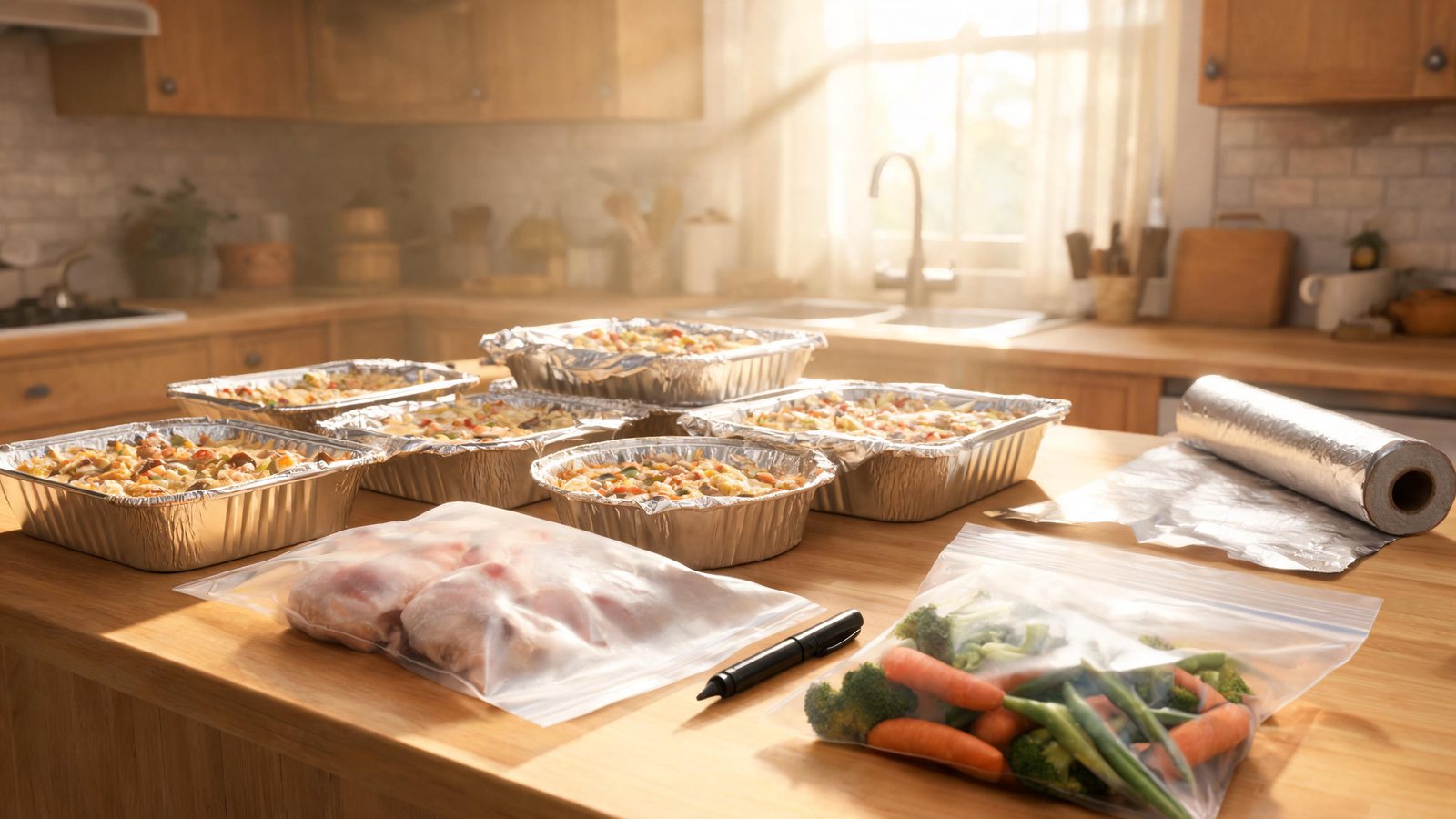
A freezer meal prep session is a cook, a cool, a label, and a freeze, in that order. Clemson Cooperative Extension says to cool prepared food quickly in ice water, freeze it once it is cool, and keep the freezer at 0°F. Label and date every package, and keep an inventory. On a later night, thaw in the refrigerator and reheat combination dishes such as stews to at least 165°F within 2 hours at an oven temperature of 325°F or higher. Soups, casseroles, and cooked meat are the types with quality months on the USDA freezing chart: 2 to 3 months for soups and stews, 2 to 3 months for casseroles, and 2 to 3 months for cooked meat, at 0°F.
The afternoon, in working order
Choose the dinners before you turn on a burner. A session of broth soups, chili, a meat sauce, and a casserole matches the rows that have quality months. Types that freeze poorly stay off the list. Which family dinners freeze well is sorted in freezer meals. A first week that mixes fridge nights and freezer nights is in how to meal prep.
Cook or assemble those dinners. If the food is already cooked, treat the cooling clock from the USDA leftovers page: into the refrigerator within 2 hours, or within 1 hour if the room is over 90°F, in shallow containers. For the freezer pack, Clemson cools the pan quickly in ice water before packaging and freezes the food as soon as it has cooled, so the ice bath comes before the handoff, not after a night in the refrigerator.
Pack in moisture-resistant containers or wraps. Fill them so air is pushed out, and leave headspace so the food can expand. Clemson also notes a wide opening, so the block can come out of the container later. For a casserole dish you want back, freeze the food in the dish, then unmold, wrap, and return the block to the freezer. That frees the dish for the next pan.
Write the food name and the date on every package. Keep a written inventory of what went in. Those two lines are on the Clemson fact sheet. A label without a date makes the quality month impossible to count.
Cool, pack, label
Speed matters at the cool step. Clemson says to set the pan in ice water or crushed ice and stir so the food cools faster, then freeze it promptly once it is cool. The USDA leftovers page is the companion rule for the first move off the stove: shallow containers, and the 2-hour limit, so a big pot is not still warm at room temperature while you bag the next recipe.
Two clocks share the number 2 and do different jobs. The USDA leftovers page uses 2 hours as the limit to refrigerate food after cooking. Clemson uses 2 hours as the limit to bring combination dishes back to at least 165°F in an oven at 325°F or higher when you reheat them. Keep those clocks separate. Cool on cook day under the leftovers page. Reheat on eat night under the Clemson line for those dishes.
What belongs in the session, and what stays out
| In the session | Quality note | Stay out |
|---|---|---|
| Soups and stews | 2 to 3 months at 0°F | Mayonnaise and cream fillings |
| Casseroles | 2 to 3 months at 0°F | Gelatin salads and custard |
| Cooked meat | 2 to 3 months at 0°F | Hard-cooked egg whites |
| Cooked poultry | 4 months at 0°F | Lettuce and cream sauce |
The quality months are the USDA freezing chart. Food held continuously at 0°F can be kept indefinitely; those months are quality. The stay-out column is the overlap of that page and the Clemson fact sheet. Clemson names mayonnaise, cream puddings and fillings, custard, gelatin salads, and the whites of hard-cooked eggs among foods that freeze poorly. The USDA freezing page names mayonnaise, cream sauce, and lettuce. A gravy thickened with ordinary flour also tends to separate, which Clemson notes; freeze the broth and make the gravy on the night you eat, if the sauce is the part you care about.
The FoodSafety.gov leftover row lists cooked meat or poultry at 2 to 6 months in the freezer. That is wider than the USDA cooked-meat row of 2 to 3 months and the cooked-poultry row of 4 months. Pack to the USDA row for the food in the bag, and read 2 to 6 months as the FoodSafety.gov leftover statement. Neither figure is a safety cutoff at 0°F.
Load the freezer so it can freeze
A session fails if the freezer cannot freeze what you add. Clemson says to put in no more unfrozen food than will freeze within 24 hours, usually 2 or 3 pounds per cubic foot of freezer space. Stack packages after they are frozen, not while they are still warm. The USDA freezing page makes the same stacking point and adds a pace: a food 2 inches thick should freeze in about 2 hours if packages are spread in one layer.
Hold the freezer at 0°F. Clemson says the temperature should not go above 0°F, because warmer or swinging temperatures cut quality. An appliance thermometer is the check. If the compartment cannot hold that temperature, this session is too large for it.
Thaw night and reheat
Thaw prepared meals in the refrigerator, which both Clemson and the USDA thaw page name. Cold water and the microwave are the other two USDA paths. Counter thawing sits outside those three. After a refrigerator thaw, reheat combination dishes to at least 165°F. Clemson wants that temperature within 2 hours at an oven temperature of 325°F or higher for those dishes, and a rolling boil for liquids. The USDA leftovers page also sets 165°F for reheating leftovers, measured with a food thermometer.
If the night is too short for a thaw, the USDA thaw page allows cooking meat and poultry from frozen, at about 50% longer than the time for thawed or fresh meat and poultry. A raw bag still needs a full cook after it thaws. A cooked casserole needs a reheat to 165°F. A slow cooker is a separate thaw rule, in slow cooker meal prep.
What a class homepage sells instead
The top results for this search are a video, a class site, and a forum thread. The video was not readable as a page. The forum thread was not opened as a page, so it is not a source. The Family Freezer homepage promotes a cooking class, a newsletter, and reusable gallon bags. The Family Freezer homepage omits a cooling-time rule and a 165°F reheat. A class can show the motions. The clocks and the stay-out list still have to come from the extension fact sheet and the USDA chart.
Labels you can print before the session
The order above is the part you can run from a blank page. A printed label and an inventory row keep the date attached to the bag.
The Prep-Ahead Freezer Dinner Kit is a print-only PDF with two prep sessions, ten family dinners, a freezer label sheet, a freezer inventory page, and a freezer basics page with sourced temperatures and storage times, in one ZIP of US Letter and A4 PDFs, 23 pages. The Prep-Ahead Freezer Dinner Kit is $8.00.
Quality guidance in the Prep-Ahead Freezer Dinner Kit is a university extension chart for freezer times, not a safety limit for these exact recipes. The session clocks on this page are Clemson and USDA, not that kit page.
The 24-hour load limit and the 0°F line are general guidance. They are not a measurement of your freezer's cubic feet, which you still have to read off the appliance.
Questions
Is it okay to freeze meal prep meals?
Yes for the types with a quality month. Food held at 0°F stays safe indefinitely; the months on the USDA freezing chart are quality. Mayonnaise, cream fillings, and gelatin salads freeze poorly, on the Clemson fact sheet.
What should I cook first in a freezer session?
Start with a broth soup or a casserole, which the USDA freezing chart lists at 2 to 3 months for quality. Cool it in an ice bath, then pack and label, which is the order on the Clemson fact sheet.
How do I keep a freezer session from warming the freezer?
Clemson says to add no more unfrozen food than will freeze within 24 hours, usually 2 or 3 pounds per cubic foot, and to stack packages only after they are frozen.